
アートのひみつ!
These three birds gazing out at the world past the familiar sea have something to do with a constellation in the night sky, as well as with the myths and ruins born in a distant past.
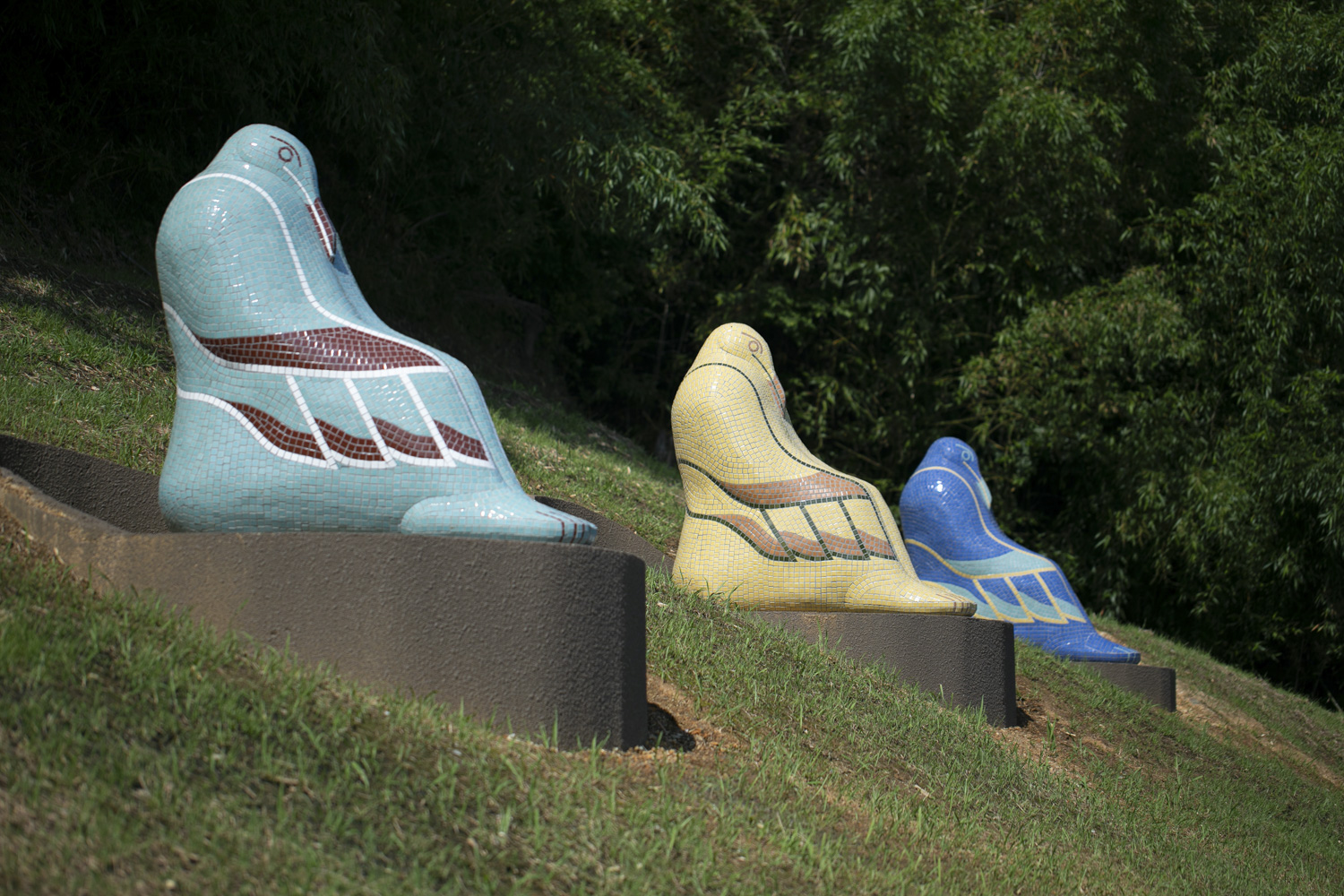
Q1. I heard that these three deities, each of whom looks like a fusion of a seabird and a human, represent the calm sea, the warm and mild climate, and the lush, green land of the Seto Inland Sea region. We heard that you named each of them. What did you call them?
Hiroko Kubo:
To make it easier to remember, I actually call them:
Mountain Bird (celadon)
Sky Bird (yellow)
Sea Bird (blue)
Q2. Why did you choose Orion, a constellation more visible in winter, and Orion’s Belt? Is it because it was one of the most important guides in ancient celestial navigation regardless of seasons?
Hiroko Kubo: When I first saw the location where my artworks would be installed, I envisioned three sculptures lined up on a site like a hill that stretched out horizontally. I’ve always been interested in the concept of trinity, a central theme in mythologies from around the world, including Greek, Egyptian, and Hindu mythologies, so that may have led me to envision these triplet sculptures.
While researching Japanese mythology, I learned that Sokotsutsuno-o no Mikoto, Nakatsutsuno-o no Mikoto, and Uwatsutsuno-o no Mikoto, all of whom were born when Izanagi washed his body, are the three deities enshrined at Sumiyoshi Shrine, and that they are identified with the three stars of Orion’s Belt.
I learned that on winter nights the three stars on Orion’s Belt rise as a vertical line from the east and set toward the west, and that their positions and angles also serve as a guide to time, making them a navigational tool. I felt this was a fitting theme for artworks to be placed in the city known for its shipbuilding industry, so I named it “Orion.” (By the way, in summer, people use the Summer Triangle as a navigational tool.)
Some researchers say that the Giza Pyramid Complex in Egypt is also modeled after the alignment of Orion’s Belt. This is nothing to do with my artwork, but interesting.
Q3. Did you get any inspiration from the shipyard that you can see from the hill?
Hiroko Kubo: I was inspired most by the scenery, the environment, and the places themselves. Industrial landscapes along the Seto Inland Sea—places like Kure and Fukuyama—are familiar sights for me since childhood. After moving to the Kanto region in recent years, I’ve been living in a completely different environment, so at first, I felt a strong sense of nostalgia. That made me want to create something wonderful that the people of my homeland would cherish for a long time.
Whenever I see construction workers working on construction sites, operating heavy machinery like large cranes to build massive structures, I feel a deep sense of respect. I enjoy watching these sites because they make me realize just how small a single sculptor is in comparison.
Q4. Do you have a message to the children growing up in this area? Perhaps you liken them to ancient adventurers of the Age of Exploration who used Orion as their navigation guide?
Hiroko Kubo: I believe that children who grow up watching ships set sail for destinations around the world right before their eyes develop a rich imagination about what lies beyond the sea.
The Seto Inland Sea region has a distinct character in each of its mountains, islands, and the sea and I think it’s a truly unique environment even on a global scale. Having visited various places both within Japan and abroad myself, I’ve come to feel this even more strongly. I hope the children will spread their wings and explore the wider world so they can truly appreciate the beauty of their hometown!
Q5. Could you tell us about the production process and medium—why you chose tiles, what challenges you faced, and what makes them such a wonderful medium for expression?
Hiroko Kubo: In creating my work, I have consistently chosen techniques and themes that have been passed down since ancient times.
I have formed my own perspectives on what has endured across the ages by examining folkloric materials and artifacts from ancient civilization you can observe in archaeological archives and museums. Objects that combine form and function—such as masks, murals, lion statues, and charms and amulets, and techniques found in various parts of the world, such as pottery, textiles, prints, and woodcarvings. Among these, the mosaic tile technique has been the one I’ve always wanted to try myself, ever since I saw 2,000-year-old works at the ruins of Pompeii in Italy. I think that one aspect of the aesthetics—or rather, the attitude—of classical sculpture is the practice of highlighting the natural color of the medium itself, rather than relying on paint.
Over the years of studying and creating sculpture, this has naturally become a guiding principle in my own artistic practice. After much trial and error in search of a medium that would allow me to fulfill my desire to create colorful outdoor sculptures without having to paint them, I found exterior wall tiles for buildings. Turquoise mosaic tile masks and ornaments from the Aztec civilization that I saw during my visit to Mexico last year also served as a major source of inspiration.
When I actually tried it, applying small tiles one by one to a large surface was a challenging task that required concentration and precision. It was particularly time-consuming to fill curved surfaces or draw fine lines, as I had to break tiles into pieces one by one to fit it into place. However, the time and effort I put in was more visible in the finished works, and this gave me a real sense of accomplishment. I also found that this medium possesses a characteristic beauty that cannot be achieved with other media. Since these tiles have the durability to be used on building facades—designed to resist deterioration and fading for decades—I feel confident that my sculptures will retain their beautiful color and strength for many years to come.
Translation: Junko Kawakami
インタビュアー
Reiko Tsubaki
a curator at the Mori Art Museum