
アートのひみつ!
These three birds gazing out at the world past the familiar sea have something to do with a constellation in the night sky, as well as with the myths and ruins born in a distant past.
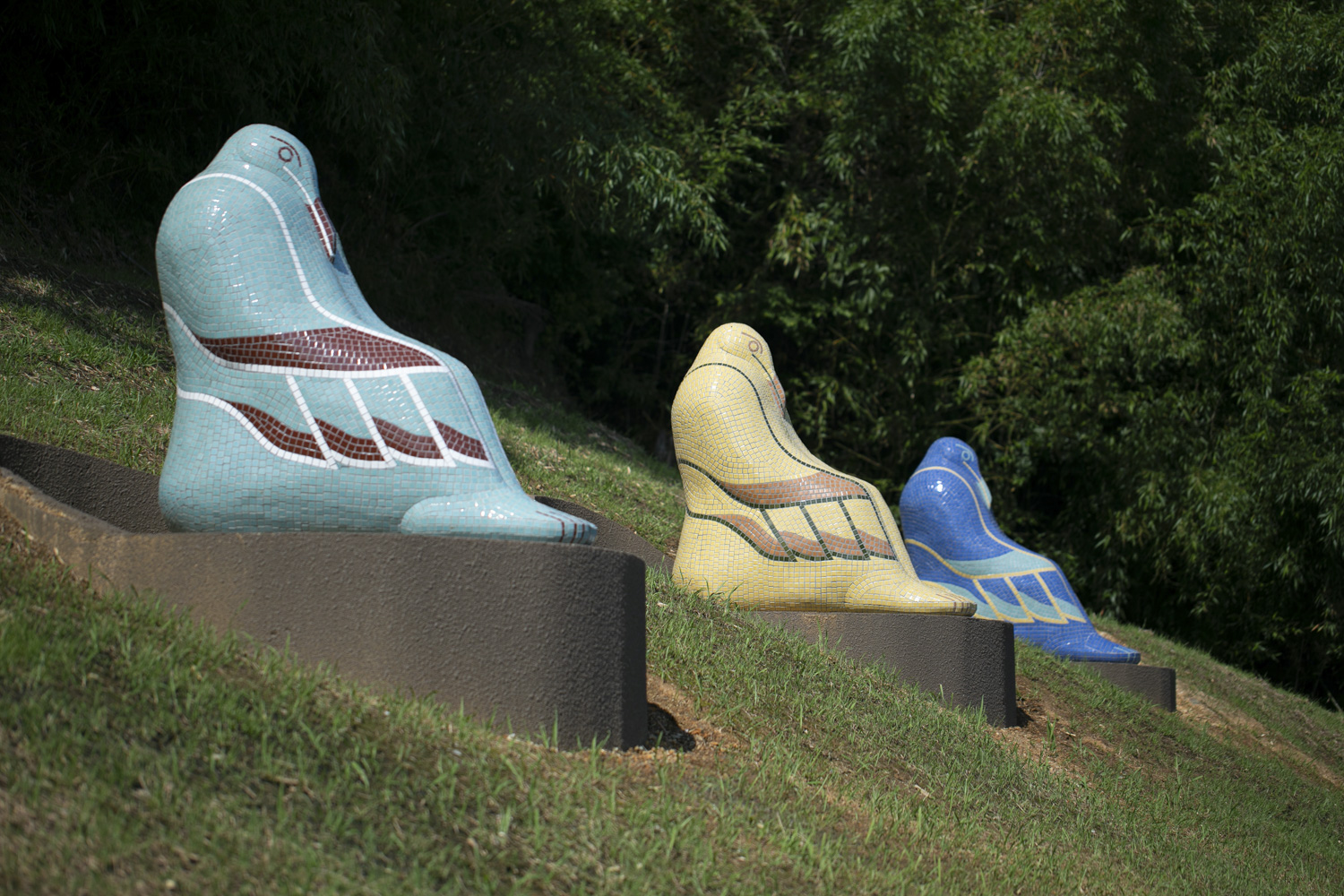
Q1. We hear that you named these three statues. What did you call them?
Hiroko Kubo: The celadon-colored statue is Mountain Bird, the yellow one is Sky Bird, and the blue one is Sea Bird. I chose names easy to remember.
Q2. Why did you choose Orion? It’s a constellation prominent in winter.
Hiroko Kubo: When I first saw this spot, I envisioned three statues lined up on a large hill. I’ve always been interested in trinities. A trinity is a group of three people or things. Trinities appear in myths around the world.
I did further research, and I learned that in Japanese mythology also has a group of three gods. They protect the sea. They are associated with Orion’s Belt, the three stars lined up in the middle of the constellation.
Sailors in the old days used the three stars as a guide when navigating the ocean at night. Since the stars move in a straight line, they served as a clue for finding direction and time.
I thought it would be the perfect theme for Tuneishi, because it is a town that builds ships. So, I named my work Orion Stars.
Q3. Did you draw inspiration from the scenery of the shipbuilding docks?
Hiroko Kubo: Yes. This time, I was greatly influenced by the scenery of this place. The industrial areas of Kure and Fukuyama facing the Seto Inland Sea are familiar sights to me since I was a child. Because I live in the Kanto region now, I don’t see them very often. So, this place brought back a sense of nostalgia.
Also, watching the craftsmen build massive ships using huge cranes is truly impressive. I was deeply moved by the sight of them working so hard to creating these structures.
Q4. Is there anything you’d like to say to the children in this region?
Hiroko Kubo: In this region, children grow up watching ships setting sail from close by. This will develop the ability to imagine what lies beyond the sea.
The Seto Inland Sea is home to mountains, islands, and the sea, and this region has a truly unique landscape. I have visited various places in Japan and abroad, and have come to appreciate its beauty all over again.
I hope that the children will cherish their hometown and spread their wings to explore the wider world.
Q5. Why did you use tiles?
Hiroko Kubo: I’ve always been interested in art forms that have been created all over the world throughout history.
Mosaic tiles are one such form. I was deeply moved by a piece I saw at a 2,000-year-old archaeological site, and I wanted to try making one myself someday.
For this project, rather than applying paint, I wanted to create a piece that highlighted the natural colors of the material itself. That is why I chose exterior wall tiles. The process of breaking and applying each small tile one by one was very time-consuming. The curved sections were particularly difficult and required a high level of concentration.
However, this effort resulted in a beauty that cannot be found in other materials. Since tiles are resistant to fading even over long periods of time, I believe this work will continue to watch over this place for many years to come.
Translation: Junko Kawakami
インタビュアー
Reiko Tsubaki
a curator at the Mori Art Museum