
アートのひみつ!
This massive ceramic artwork weighs 700 kg. There’s a reason why it is this big. Your voice echoes inside it. You can sit on the stone walls with others. You can feel different fruit trees in different seasons. Let’s gather in this space that’s like a plaza.
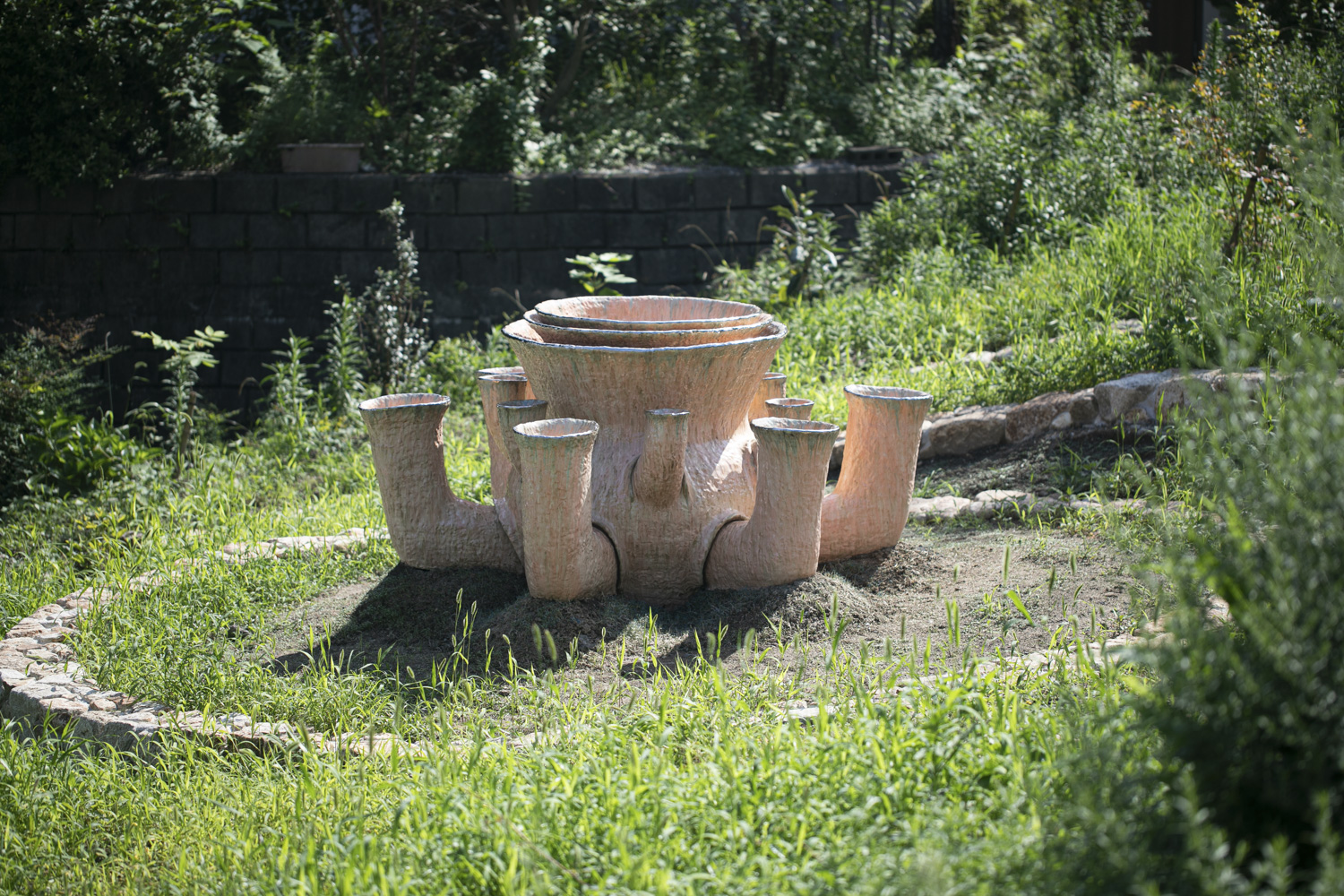
Q1. Please tell us about the inspiration for this work and the kernos motif.
Akane Saijo: The Tsuneishi area, facing the Seto Inland Sea, is blessed with a mild climate. The mountain slopes are planted with many fruit-bearing trees nurtured by this bountiful climate. I was deeply impressed by the variety of fruit-bearing trees—including citrus fruits like mandarins and lemons, as well as loquats, chestnuts, and figs—planted at the installation site and its surroundings.
The term “kernos” in the title refers to an earthenware vessel used in ancient Greek rituals, consisting of a series of interconnected bottles. It is said that people would place various plants and grain seeds inside or circulate liquids through them to pray for a bountiful harvest. In particular, they say that once a year, large crowds would gather at the massive stone kernos found at the ruins of the Palace of Malia on the island of Crete to offer their prayers.
Drawing inspiration from this historic object of prayer, I created this work with the hope of celebrating the abundance of Tsuneishi’s fruit trees and all forms of life, and with the aim of creating a plaza-like space where adults and children from the town could gather periodically to experience the changing seasons.
Q2. Could you tell us a bit about the form of the work and its resemblance to an organism or a living entity?
Akane Saijo: Large ceramic sculptures often feature a hollow, tube-like core to ensure uniform drying and prevent explosions during firing. In fact, the human body is also, biologically speaking, a similar tube-like structure—a single continuous passage from the mouth to the rectum. My aim is for the hollow interior of the ceramic piece to connect with the human body when a person’s voice or breath resonates within it, creating a resonance that merges the body and the ceramic’s hollow space as though they were a single living entity. This is the reason behind the organic form of the work.
Regarding the color, I drew inspiration from the terracotta hues of a kernos, while consciously seeking tones and textures that evoke the sensation of living beings—somewhat reminiscent of skin or mucous membranes.
I chose an even number for the 6 × 6 configuration because I wanted to create a structure where it feels as though someone is positioned diagonally across from the person blowing into the piece. I arrived at this form by considering the sense of physical distance and the spatial balance when people interact with the work. Furthermore, rather than having the pieces simply rest on the ground, I aimed for a form that appears to arise from the ground itself.
Q3. What was the most challenging part of the creation process?
Akane Saijo: This piece weighs about 700 kg in total. Since it weighed about 1 ton before firing, it’s obviously impossible to move it by myself. Although we sometimes use machines like forklifts, ceramic pieces are most fragile before firing, so we loaded it into the kiln by hand. With the help of about five adults working together to move it bit by bit, we were able to successfully load it into the kiln.
Also, given its size, it was important to fire it slowly. It took about a week from the time it was loaded into the kiln until it was fully fired and cooled.
Q4. What are your thoughts about involving physical communication through voice and breath?
Akane Saijo: Trying out vocalizations within the artwork, letting our voices resonate together, or gathering a few people to do this since there are so many holes—in that way, I hope situations where interactions between people naturally arise. I believe there will be moments of harmony, as well as disharmonious moments.
What I’m always thinking about is creating moments where the relationship between people and objects is reversed. When touching a small object like a tea bowl, you “hold” it, but when the object is larger than your body, you “entrust your body” to it. I believe that the scale is a key element that disrupts the relationship between people and objects.
Q5. Could you tell us about the relationship of the art to the surrounding fruit trees and landscape?
Akane Saijo: We planted fruit trees such as figs, loquats, and lemons, which ripen in different seasons. I hope this will become a place where children can experience the changing seasons. Surrounding the artwork is a stony landscape that spreads out like ripples. I hope people can sit down for a moment to rest, eat ripe fruit, and enjoy the seasons. As the fruit trees continue to grow and spread their leaves, they will create shade, and I hope this will become a gathering place for people.
Q6. What do you think about the effects of aging and the concept of time in public art?
Akane Saijo: The kernos pottery I saw with my own eyes was created around 2000 BCE, and the peeling and wear of its decorations—resulting from the passage of time—gave the material a powerful allure. I hope that this work, too, will spend a long time alongside the town’s residents and fruit trees, becoming deeply rooted in the landscape in just that way.
Just like the kernos found at the Palace of Malia ruins, I hope this piece will be a place where people can pray for the abundance of all crops and life and feel the changing of the seasons—as well as a plaza-like space where local children and adults can gather periodically to connect with one another. It would be ideal if it could exist as a sort of border between the everyday and the extraordinary—a presence that, while part of daily life, makes people pause for a moment and feel a sense of prayer or gratitude.
Translation: Junko Kawakami
インタビュアー
Reiko Tsubaki
a curator at the Mori Art Museum