
アートのひみつ!
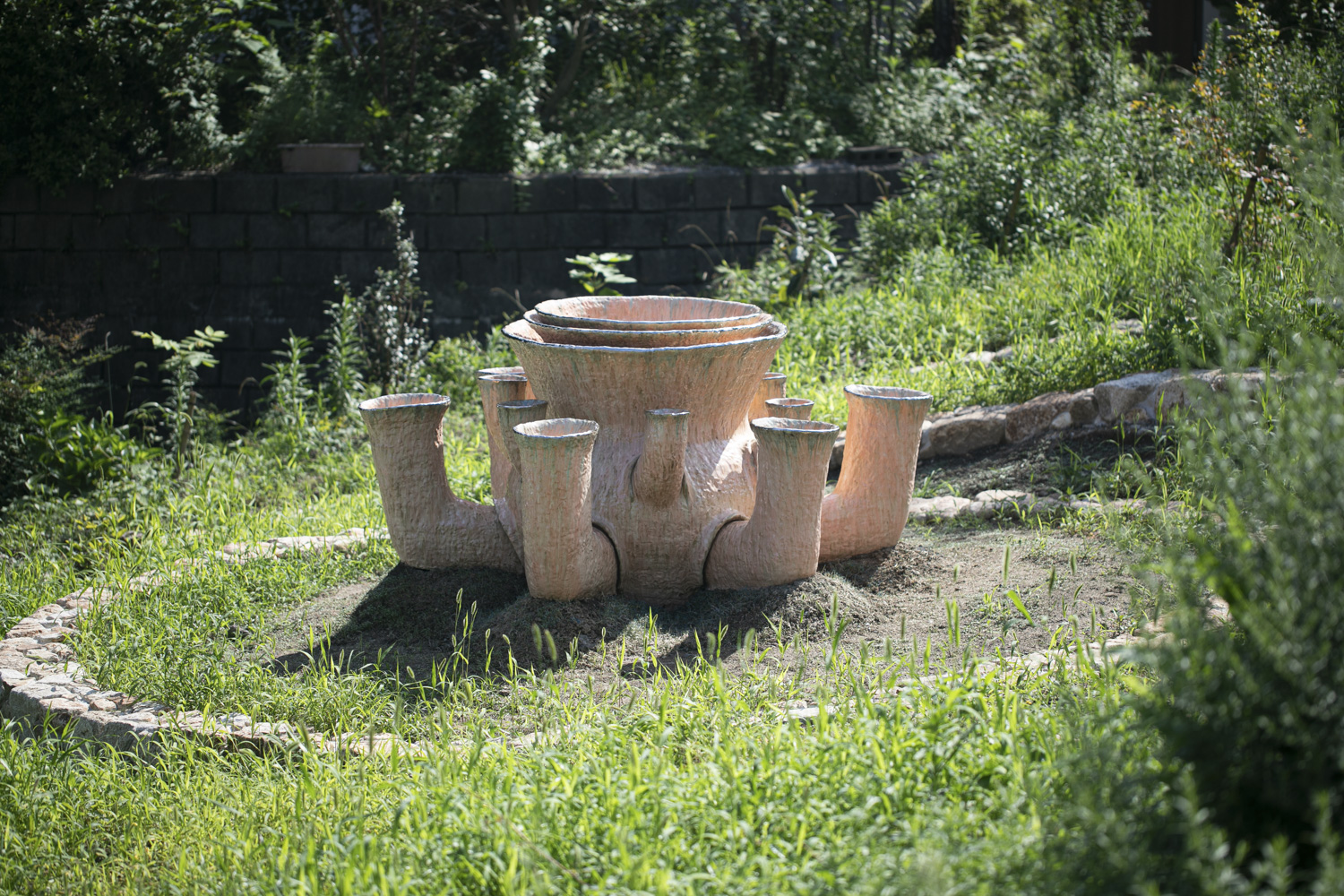
This massive ceramic artwork weighs 700 kg. There’s a reason why it is this big. Your voice echoes inside it. You can sit on the stone walls with others. You can feel different fruit trees in different seasons. Let’s gather in this space that’s like a plaza.
Q1. What inspired this work?
Akane Saijo: Mandarin orange, lemon, loquat, fig, chestnut… many fruit trees grow in this area. I was moved by the bounty of this land, so I wanted to celebrate it.
I took inspiration from an ancient Greek vessel called a kernos. It’s a pottery ring holding several pots, and people in ancient times used to offer seeds and food as they prayed for a bountiful harvest.
Q2. Why did you make this so big? It must have been a challenging task.
Akane Saijo: A small tea bowl is something you “hold” in your hands, but an object bigger than yourself is something you “give yourself” to. I wanted to create a moment in which the relationship between the work and the viewer would be reversed. I would like you to feel how big it is with your entire body.
The entire work weighs around 700 kg. It even weighed 1 ton before firing in the kiln, so I cannot move it on my own. Since a ceramic work is most fragile before firing, we loaded it into the kiln not by machines but by hand.
Around five adults worked together to move it bit by bit so we could succeed in loading it into the kiln safely.
Q3. What happens when you speak into the hole?
Akane Saijo: When you speak into the hole, your voice echoes inside the artwork. You can also hear the voices of people speaking into the adjacent holes. When your voice resonates, you’ll feel as though your body and the artwork have become one. Why don’t you give it a try?
Q4. Why did you plant fruit trees around the artwork?
Akane Saijo: I planted trees of fig, loquat, lemon and so on. They bear fruits in different seasons. In spring, summer, fall, and winter… whenever you visit here, you will find different trees and fruits. When you come, I would like you to feel, “Oh, it’s already autumn,” or “The fruits are ripe this year again,” and so on. That’s why I planted fruit trees of different seasons.
Q5. What kind of place would you like this space to be?
Akane Saijo: I hope it becomes like a plaza, like a place where people gather with friends and family, sit down for a rest on the wide area of stacked stones and eat ripe fruit. As the fruit trees continue to grow and spread their leaves, they’ll provide shade. I’d be happy if this became everyone’s favorite spot.
Translation: Junko Kawakami
インタビュアー
Reiko Tsubaki
a curator at the Mori Art Museum