
アートのひみつ!
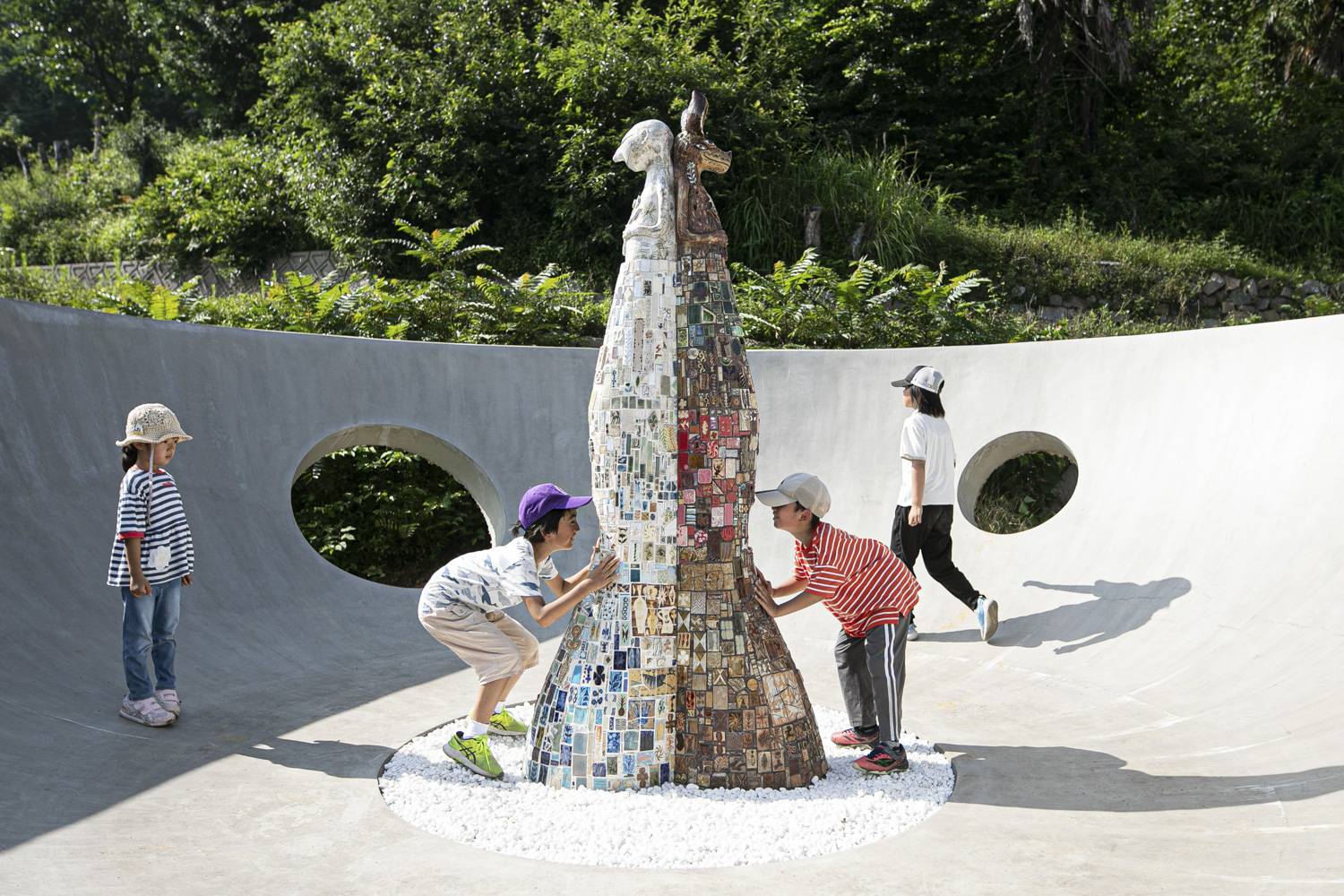
This tower with a human and wolf standing back-to-back is covered by handmade tiles. The traffic mirror gives a glimpse into a mysterious world. How did the artist create them?
Q1. Where did the concept of two towers—each with a human and a wolf standing back-to-back—come from?
Yusuke Asai: My initial vision was of two towers, each divided into about four levels and featuring tiles of different colors on each level, standing back-to-back as a single unified structure. I have used the back-to-back motif repeatedly in my previous paintings, and that idea naturally carried over into this three-dimensional work.
I chose the form of a tower because I wanted to create something taller than the children walking to school. When they are small children, the base of the tower comes into view; as they grow taller, their gaze shifts to the central section with the opening, and eventually to the top. I intended to evoke the experience of how one’s relationship with the artwork changes as one grows up.
While it’s best for viewers to simply enjoy the artwork as they see it, if I were to further explain why I placed two different creatures––a human and a wolf––back-to-back, I’m interested in the sensation that arises when different elements coexist and influence one another. For example, when I’m painting, there are times when I feel a sense of response—without any clear reason—to a brushstroke I’ve casually applied. It’s less a matter of creating something solely from within myself, and more a sensation that comes from something outside of me—or from a part of myself that is the exact opposite—something akin to what people in the past used to call a “premonition.”
In Japan today, the bear problem is becoming more serious with each passing year, but I wonder if that’s because we’ve been treating bears as distant neighbors. If we adjust our perspectives to view them as cohabitants, we’ll find more common ground, and we’ll be able to see the problem from a slightly different angle. That’s what I’m trying to convey through my art. It’s very important that, on this planet—our shared home—we can coexist peacefully and intimately, even as we look in different directions.
Q2. What meaning do you imbue in the wolf motif?
Yusuke Asai: Four-legged beasts like wolves are an indispensable motif in my work. In mythologies around the world, wolves are often portrayed as an unstoppable threat of nature; in the West, they are depicted as creatures vanquished by heroes, while in Asia, they are described as beings that will bring a curse upon those who kill or drive them away.
However, what I depict is not that mythical ferocity, but a much more timid creature. While representing nature, it constantly observes its surroundings with caution to survive, reacting sensitively to the presence of humans and other beings and quietly hiding itself. The fact that many such creatures exist within my paintings signifies that it is a rich ecosystem.
Q3. I’ve heard that you have ties with hunters and that has influenced your work.
Yusuke Asai: I’ve been using deer blood in my work since 2019, and to obtain it, I’ve been taken on several deer hunts by Nozomu Onodera, a subsistence hunter living in Ishinomaki, Miyagi Prefecture. When walking through the mountains with him, I noticed that he would attune himself deeply to the mountains—his eyes and ears, and to put it more dramatically, even his very weight, seemed to change as if he were blending into the surroundings.
As we walked through the mountains together, there were moments when the hunter sensed something and came to a sudden halt. This, too, is a premonition. I believe that not only the beasts lurking in the forest before us, but also our Jomon ancestors likely lived with this kind of physical sensitivity.
Q4. Please tell me about the concept of the Lord of the Mountain.
Yusuke Asai: The Lord of the Mountain is a being that secretly dwells deep within mountains and rivers, presiding over that realm. What’s interesting is that the Lord is said to dwell not in a pristine place, but in a stagnant area. If an area is over-manicured and becomes too well-ventilated, it actually disrupts the balance of the ecosystem. Just as fish cannot live in water that is too clean, it takes a certain kind of roughness or stagnation to nurture diverse life.
Q5. Please tell us about soil as a medium and the collaborative creation process.
Yusuke Asai: I’ve been using soil since 2008. Before that, around 2003, I started creating wall art using masking tape, and I also worked with acrylics and watercolors. Soil is a living material that contains microorganisms, and it has its own unique state and character. The process of creating while attuning my hands to the soil’s condition feels like a dialogue with the soil itself. Even when I think I’m working alone, I’m constantly aware of the presence of the living creatures that dwell within the soil.
For this tile project, I’m also using soil collected from Tsuneishi in Fukuyama. I found that, compared to soil from other regions, it has a notably higher viscosity.
When creating my work, I also research the history of the local area. As I investigate the locations of shrines, ancient burial mounds, and archaeological sites, I’ve noticed that these structures tend to be concentrated on plateaus. I believe that ancient people determined these locations not through knowledge, but through physical intuition.
Q6. Please tell us about your approach to tile-making and your choice of colors.
Yusuke Asai: Tiles were a medium I worked with in earnest for the first time specifically for this project. My experience learning the basics in the ceramics club during high school served as a foundation, but as I continued to experiment, the number of tiles—which I had originally planned to be 400 to 500—ended up reaching about 4,000.
Each tile features a small image, and depending on which images are placed next to one another, a new story emerges. This approach—where a larger narrative arises before I even realize it through the accumulation of small elements—has been my style since my days creating two-dimensional works.
The fact that people from Tsuneishi and others involved in the project went out of their way to come to my studio to help create the tiles is of great significance to this project. Soil, by its very nature, does not belong to any single individual; it belongs to all living creatures that inhabit the earth. The involvement of others is akin to the fermentation process of a rice-bran bed; these small interventions lead to major changes, imbuing the work with a complex atmosphere and a multitude of stories.
What I focused on most was considering the infinite number of possible combinations. It’s not as if I simply had to display only the best pieces; I also made a point of including many of the poorly made pieces I created as test samples early on, as well as plain, unadorned items. It took me an especially long time compared to other works I’ve created in my career; but now, looking at the final result, I’m very satisfied.
Q7. Please tell us about the entire space, particularly the collaboration with the landscape design, and the mirror installation.
Yusuke Asai: Initially, I envisioned that the landscape would be something like a plaza with a tower protruding from a wooden deck, but I was truly surprised when Mr. Kiyoaki Takeda, the architect, and his team sent us the proposal for that bowl-shaped landscape. I thought there could be nothing more wonderful than having the entire space become a work of art.
When you enter the bowl-shaped landscape through the entrance, proceed to the very back, and look back, you can see small mirrors in the distance beyond the large opening through which you entered. The experience of finding yourself within this carved-out circular space, as well as within the reflection of the circular mirrors on the outer perimeter, is intended to evoke a sense of immersion, as if you’ve wandered into an ancient ruin or a place of prayer.
I proposed the artwork for the traffic mirrors somewhat as a “bonus,” and it was accepted. This stems from my long-standing fascination with the countless objects found throughout the town, such as utility poles and traffic cones. I hope that when people see the mirrors featuring my artwork and then look at other ordinary mirrors, they’ll let their imagination run wild. My wish is for them to rediscover everyday scenery as a canvas.
Q8. Is there anything you’d like to share with the children?
Yusuke Asai: Since the artwork is located in an open space like a park, it’s perfectly fine for them to treat it as a playground. However, the Takaramichi Project was created with a great deal of care and thought—from the Tsuneishi team to the director—so I hope they’ll engage with it in a way that’s a little different from how they usually play. For adults, it might be an experience of appreciating art, but I want children to be freer and make their own unique discoveries.
All the tiles are handmade, and each one features a different image. With nearly 1,000 tiles, it’s practically impossible to memorize them all. But every time you visit, depending on your mood that day, you should be able to find your very own treasure. I’d be delighted if you could engage with this artwork over the long term as a place to cultivate your “ability to see.”
Translation: Junko Kawakami
インタビュアー
Reiko Tsubaki
a curator at the Mori Art Museum